

Welcome to the weekly highlights and analysis of the blueteamsec (and my wider reading). Not everything makes it in, but the best bits do.
Operationally this week Moltbot (Openclaw) instances exposed to the Internet have been driving some of the tempo (see reflections below).
In the high-level this week:
How to prepare for and plan your organisation’s response to severe cyber threat: a guide for CNI - UK National Cyber Security Centre guides - “Cyber incidents targeting organisations – particularly those against critical national infrastructure (CNI) – are becoming more frequent, sophisticated and potentially destructive. This is happening against a backdrop of greater geopolitical instability, rapid technological advances, and increasingly capable adversaries. In an environment where cyber threat escalates to ‘severe’, it is feasible that highly capable threat actors would target the UK’s CNI to cause major disruption.”
One small step for Cyber Resilience Test Facilities, one giant leap for technology assurance - UK National Cyber Security Centre announces - we pioneered Principles-Based Assurance. Last year we announced the first Cyber Resilience Test Facilities to assess products against our principles. We are now pleased to announce that the first products to go through CRTFs have now had their reports issued.
Secure AI infrastructure: call for information - Department for Science, Innovation and Technology, National Cyber Security Centre and AI Security Institute call - “This notice is a call for information to gather views from the AI sector, the cyber security sector, and wider industry and academia. It will help government gain a broader understanding of the security challenge, current capabilities, practical constraints, and promising directions for research and technical pilots.”
“The UK has a globally leading track record and extensive sovereign capabilities in designing, building and assuring high‑assurance digital systems, including trusted computing and cross‑domain solutions. Through this programme, the UK will build on its capabilities and work with experts across industry and academia to develop, test, and mature the next generation of secure AI infrastructure, helping to ensure the UK is a trusted location for frontier AI development and deployment”
UK-Japan strategic cyber partnership - Foreign, Commonwealth & Development Office and Prime Minister's Office 10 Downing Street announce - “Building on the Japan-UK Cyber Partnership established as a part of “The Hiroshima Accord: an Enhanced Japan-UK Global Strategic Partnership” in 2023, the Participants concurred on upgrading their cyber cooperation into a Strategic Cyber Partnership. The Participants reaffirm the benefits of close collaboration, including on information sharing, developing technical standards, international law and norms, protecting critical national infrastructure, and the development and deployment of cyber technologies.”
UK leaders warned country risks ‘absorbing’ cyber and hybrid attacks without offensive deterrence - The Record reports - “Jarvis said the government will publish a refreshed National Cyber Action Plan in the spring, shifting from a strategic framework to a more operational plan focused on countering threats, strengthening resilience and supporting economic growth. He cited recent cyberattacks on major British companies as evidence of escalating risk, and said ransomware legislation remains under consideration following consultation with allies.”
Energy Sector Incident Report - 29 December 2025 - CERT Poland detail - “On 29 December 2025, in the morning and afternoon hours, coordinated attacks took place in Polish cyberspace. They were directed at more than 30 wind and photovoltaic farms, a private company from the manufacturing sector, and a large combined heat and power plant supplying heat to almost half a million customers in Poland.”
The cybersecurity dilemma game: moving cybersecurity beyond solutionism - Torben Elgaard Jensena, Laura Kocksch and Susann Wagenknecht publishes - “Faced with ubiquitous cyber-attacks, the field of cybersecurity is scrambling to develop both technical solutions as indicated by incessant streams of updates, and social solutions as indicated by a surge of awareness campaigns. However, it is increasingly clear that the dominating underlying narrative of solutionism – the conviction that relatively neat technical or social fixes can be found to well-defined problems – is strangely out of sync with a substantial part of everyday practices of securing IT.”
France’s National Cyber Security Strategy 2026 - 2030 - Government of France publishes - is made up of five pillars:
Making France the largest pool of cyber talent in Europe
Strengthening the nation's cyber resilience
Halting the expansion of cyber threats
Maintaining control over the security of our digital foundations
Supporting the security and stability of cyberspace in Europe and internationally
Annual Report - The Constitution Protection Bureau of Latvia issues - “Russia continued to pose the main cyber threat to Latvia due to Russian strategic goals in general as well as the military, political, and other types of material and psychological support Latvia provided to Ukraine in its defensive efforts against Russia” … “Cyber threats to operational technologies were also a cause for growing concern. Operational technologies are equipment and software used to monitor and control physical processes, devices, and infrastructure to provide, among other things, essential public services – energy, water supply, and transport.”
Adopting a Risk-based Approach to Software and Hardware Security - Executive Office of the President - Office of Budget and Management issue - "Agencies shall continue to maintain a complete inventory of software and hardware and develop software and hardware assurance policies and processes that match their risk determinations and mission needs. Agencies may choose to use the government-wide secure software development resources developed under M-22-18, such as the Secure Software Development Attestation Form. Agencies may also choose to adopt contractual terms that require a software producer to provide a current software bill of materials (SBOM) upon request.”
Trump Administration Science & Technology Highlights: Year One - The White House publishes - “launched FedRAMP 20x,a cybersecurity authorization pilot program to accelerate Federal use approval for cloudbased AI solutions”.. “In June 2025, DOE’s Office of Cybersecurity, Energy Security, and Emergency Response launched the AI For Operationally Resilient Technologies and Systems initiative” etc..
Joint Statement Endorsing Principles for 6G: SECURE, OPEN & RESILIENT BY DESIGN - National Telecommunications and Information Administration issue - “The Governments of the United States, Australia, Canada, the Czech Republic, Finland, France, Japan, the Republic of Korea, Sweden, and the United Kingdom concur on these shared principles for the research and development of 6G wireless communication systems; and recognize that by working together we can support open, free, global, interoperable, reliable, resilient, and secure connectivity.”
Israel moves forward with potential game-changing cyber law - Jerusalem Post reports - “Under the cyber law proposal, if there is “potential grave damage” to the country, “critical” private-sector and government agencies would be required to report a cyberattack immediately and in real time.”
Department of Energy trains utilities, protection teams to defend the grid on Plum Island - Idaho National Laboratory exercises - “Now, the 840-acre island’s national security legacy continues through an annual exercise known as Liberty Eclipse. This exercise trains power companies, industry experts, and government officials to respond to cyberattacks that could disrupt the flow of commercial electricity and natural gas.”
Ukraine’s new defence minister vows data-driven overhaul of military - Reuters reports -
“Ukraine has systematically logged wartime statistics
Data trove valuable for training AI models
Ukraine’s data seen as negotiation leverage with allies
Ukraine to test homegrown DJI Mavic drone replacement”
Italy Contributes Nearly €1 Million to Strengthen Cybersecurity in Ternopil Region - State Service for Special Communications and Information Protection of Ukraine announces - “Italy has allocated almost €900,000 to enhance cyber resilience in Ukraine's Ternopil region. The projects will be implemented under the Tallinn Mechanism, an international initiative aimed at helping Ukraine counter cyber threats. An additional €100,000 has been earmarked to support the Tallinn Mechanism Project Office (TMPO) based in Kyiv. In total, Italy's contribution to strengthening Ukraine's cybersecurity amounted to €1 million.”
How Computer Warfare Is Becoming Part of the Pentagon’s Arsenal - New York Times reports - “In an interview, Katherine E. Sutton, the Pentagon’s top cyberpolicy official, declined to discuss Venezuela or other recent operations, but said the military was focused on how to integrate cybereffects into broader military operations. She said those capabilities had been used alongside traditional military power to “successfully layer multiple effects” on the battlefield.”
From Reform to Results: Incentives, Culture and the UK’s Military Intelligence Services - RUSI think tank - “The reform consolidates previously dispersed military and civilian intelligence personnel under a single Defence-led structure, located within Cyber and Specialist Operations Command (itself recently rebranded from UK Strategic Command). According to the MoD, the objective is to improve coherence, speed and resilience in response to an increasingly contested security environment, while implementing recommendations from the 2025 Strategic Defence Review.”
County pays $600,000 to pentesters it arrested for assessing courthouse security - Ars Technia reports - “Two security professionals who were arrested in 2019 after performing an authorized security assessment of a county courthouse in Iowa will receive $600,000 to settle a lawsuit they brought alleging wrongful arrest and defamation.”
New Innovations for Agility in Cyber Regulation and Compliance - Jason Healey at Columbia University’s School for International and Public Affairs opines - “How AI, automation, and continuous testing could replace checklist cyber compliance with faster, cheaper, and more resilient regulation.”
‘Chilling’ hacking network is targeting vulnerable children, charity warns - The Guardian reports - “The Molly Rose Foundation (MRF) said online networks linked to a global ecosystem labelled the Com were carrying out extreme exploitation, cyberbullying, violence and abuse – and called for a coordinated global response from governments, regulators, law enforcement and tech companies.”
Reporting on/from China
The “Fangban” Practice of the “Three-Stage Three-Integration” Training Model for Practical and Innovative Cybersecurity Talents under the National Cyber Power Strategy - Fangban cites - “The program has yielded remarkable results, with students publishing over 300 high-level academic papers, applying for over 200 invention patents, and winning over 100 national first prizes in major academic competitions. It has successfully completed cybersecurity protection tasks for nearly 20 major national events, including the Winter Olympics and the Canton Fair, as well as nearly 100 government cybersecurity protection operations with zero incidents. Students have been selected for the list of the world's most valuable cybersecurity researchers.”
Digital Yuan Overhaul Targets Mass Adoption, Cross-Border Use - Caixing Global reports - “Under the new plan, the digital yuan moves from an era of digital cash into what Lu called the digital deposit money era. In practical terms, the digital yuan is positioned as a modern tool for payment and circulation issued and used within the financial system, with the central bank providing technical safeguards and oversight, but with commercial-bank liability attributes. It will be account-based, compatible with features of distributed-ledger technology, and designed to serve as a unit of account, a store of value and a vehicle for cross-border payments, according to the plan.”
China’s UBTech partners with Airbus to bring humanoid robots to aviation manufacturing - South China Morning Post reports - “The deal follows a similar one with US semiconductor maker Texas Instruments, underscoring the Chinese firm’s accelerated overseas push”
Unitree Defends Robot Sales as Rival Claims Market Crown - Caixing Global reports - “Unitree Robotics disputed rival sales reports on Thursday, asserting it shipped over 5,500 humanoid robots in 2025 amid rising competition in the rapidly evolving sector. The disclosure highlights a broader industry challenge: the absence of unified standards for what constitutes “mass production.” As the market shifts from stunt-driven prototypes to scalable commercial deliveries, companies are scrambling to define leadership.”
Alibaba Plans Spinoff of Chip Arm T-Head Amid AI Boom - Caixing Global reports - “Founded in 2018, T-Head designs proprietary chips used in Alibaba's cloud business and enterprise servers. It debuted its first AI inference chip, the Hanguang 800, in 2019 and introduced the Arm-based Yitian 710 CPU in 2021. Development of the PPU, a general-purpose GPU for AI training and inference, began around 2020.”
AI
Automated vulnerability discovery: past, present and future – where are the limits of AI? - Tencent outline - “So, where is the current boundary?
The depth of context understanding remains limited. Although the context window has been expanded to the level of millions of tokens, the model’s ability to truly understand the global state of a complex codebase is still far from reaching the level of human experts. It can “see” all the code, but it may not be able to grasp the subtle relationships between the code.
The scarcity of domain knowledge is also a bottleneck. For emerging protocols, new hardware features, and rare vulnerability types, the training data for models is naturally insufficient. In these cases, carefully designed prompts, RAGs, and knowledge bases are still needed to activate the model’s relevant knowledge and suppress illusions. The value of knowledge engineering is particularly prominent in these “edge scenarios.”
Benchmarking LLAMA Model Security Against OWASP Top 10 For LLM Applications - Nourin Shahin and Izzat Alsmadi benchmark - “Our results reveal significant differences in security performance: the compact Llama-Guard-3-1B model achieved the highest detection rate of 76% with minimal latency (0.165s per test), whereas base models such as Llama-3.1-8B failed to detect threats (0% accuracy) despite longer inference times (0.754s). We observe an inverse relationship between model size and security effectiveness, suggesting that smaller, specialized models often outperform larger general-purpose ones in security tasks”
Stealing AI Models Through the API: A Practical Model Extraction Attack - Praetorian demonstrate in the lab - “To illustrate the attack, we built a fully reproducible demonstration using Fashion-MNIST, a dataset of clothing images that serves as a stand-in for any image classification API.”
An AI Toy Exposed 50,000 Logs of Its Chats With Kids to Anyone With a Gmail Account - Wired reports - “AI chat toy company Bondu left its web console almost entirely unprotected. Researchers who accessed it found nearly all the conversations children had with the company’s stuffed animals.”
AI found 12 of 12 OpenSSL zero-days (while curl cancelled its bug bounty) - Stanislav Fort sheds some light on the time lines - “In late summer 2025, 6 months into starting our research, we tested our AI system against OpenSSL and found a number of real, previously unknown security issues .. In the Fall 2025 OpenSSL security release, 4 CVEs in total were announced from 2025 (of the format CVE-2025-*), out of which 3 were found, responsibly disclosed and in some cases even fixed by us (or more precisely by our AI system) … Out of the 12 new CVEs, 10 were assigned CVE-2025-* identifiers and 2 already belong to the year 2026 with CVE-2026-*s. Adding this to the 3 out of 4 CVEs we already had in 2025 previously”
AISLE discovered 12 out of 12 Vulnerabilities in OpenSSL - would be good to understand the false positive and/or triage costs along with the token costs.
Sec-Context - AI Code Security Anti-Patterns for LLMs - Arcanum publish - “AI Code Security Anti-Patterns distilled from 150+ sources to help LLMs generate safer code. Use as context for AI assistants or deploy as a standalone security review agent.” - looking forward to the performance / efficacy measurement
Silent Brothers | Ollama Hosts Form Anonymous AI Network Beyond Platform Guardrails - Gabriel Bernadett-Shapiro & Silas Cutler detail - “open-source AI deployment has created an unmanaged, publicly accessible layer of AI compute infrastructure spanning 175,000 hosts worldwide, operating outside the guardrails and monitoring systems that platform providers implement by default and Over 293 days of scanning, we identified 7.23 million observations across 130 countries, with a persistent core of 23,000 hosts generating the majority of activity.”
Operation Bizarre Bazaar: First Attributed LLMjacking Campaign with Commercial Marketplace Monetization - Eilon Cohen and Ariel Fogel - “honeypot mimicking exposed AI infrastructure observed real-world attack patterns - including the first public documentation of a named and attributed LLMjacking marketplace operation (Operation Bizarre Bazaar) and a separate MCP reconnaissance campaign… reselling discounted access to 30+ LLM providers without legitimate authorization. Hosted on bulletproof infrastructure in the Netherlands, the service markets on Discord and Telegram while accepting cryptocurrency and PayPal.”
Expert Insight: China’s AI Services Registry System, A Complete Guide - Oxford China Policy Lab outline - “China requires companies to register AI services before launch through a “2-3-4-3-2” system: two AI service categories, three foundational regulations, four public registries, three review processes, and two disclosure channels. Regulations apply only to AI services with the capacity to “shape public opinion” or “mobilize society”, definitions of which are left up to the regulator’s discretion.”
Cyber proliferation
Industry, government, nonprofits weigh voluntary rules for commercial hacking tools - CyberScoop reports - “A foreign government representative at the event said the goal of the Pall Mall Process isn’t to eliminate commercial intrusion products that can help in legitimate pursuits like law enforcement, but to establish rules of the road for their responsible government use and purchase from responsible vendors.”
Spyware in Europe and the Paragon case, there is a new (informal) commission of inquiry against the abuse - Wired Italy reports - “Stop spyware abuse in Europe and a direct appeal to victims: report them . These are the first demands of the European Parliament's new intergroup dedicated to spyware , which will be presented on January 21 in Strasbourg. Sandro Ruotolo , MEP for the Progressive Alliance of Socialists and Democrats group (elected within the Democratic Party) and the initiative's initiator, calls it an "informal commission of inquiry" into abuse.”
Saudi dissident awarded $4.1 million by UK court for hacking - Reuters reports - “The 45-year-old satirist, who has lived in Britain since 2003 and been granted asylum, said discovering he had been hacked caused severe depression and effectively ended his lucrative work producing YouTube content.
Bounty Hunting
Investigation into International “ATM Jackpotting” Scheme and Tren de Aragua results in Additional Indictment and 87 Total Charged Defendants - US Department of Justice announces - “A federal grand jury in the District of Nebraska returned an additional indictment charging 31 individuals for their roles in a large conspiracy to deploy malware and steal millions of dollars from ATMs in the United States, a crime commonly referred to as “ATM jackpotting.” Fifty-six others have already been charged.”
Government Forfeits Over $400M in Assets Tied to Helix Darknet Cryptocurrency Mixer - US Department of Justice announces - “Helix blended cryptocurrency from multiple users and routed the funds through a series of transactions designed to obscure the funds’ sources, destinations, and owners.”
No Place Like Home Network: Disrupting the World's Largest Residential Proxy Network - Googles announces - “included three main actions… [including] … Took legal action to take down domains used to control devices and proxy traffic through them.”
Former Google Engineer Found Guilty of Economic Espionage and Theft of Confidential AI Technology - US Department of Justice announces - “According to the evidence presented at trial, between approximately May 2022 and April 2023, while a Google employee, Ding stole more than two thousand pages of confidential information containing Google’s AI trade secrets from Google’s network and uploaded them to his personal Google Cloud account.”
Market Incentives
Data Protection Commission owed more than €4 billion in fines - Irish Times reports - “The Data Protection Commission (DPC) is owed more than €4 billion in fines that have not been collected or are subject to legal challenge. The DPC hit companies – including firms in Big Tech – with more than €530 million in fines last year. However, just €125,000 of that has been collected so far, according to data released under FOI laws.”
SonicWall Breach Enabled Ransomware Attack on 74 US Banks - CtrlAltNod reports - “Marquis is pursuing legal recourse against SonicWall and evaluating options to recover expenses from the incident”
South Korean police to question interim CEO of Coupang in data breach probe - Economic Times reports - “A task force at the Seoul Metropolitan Police Agency summoned Rogers to question him on suspicion of evidence tampering while Coupang was conducting an internal investigation into the breach, the Yonhap News Agency reported”
Before we begin this week as mentioned in the opener Moltbot (Openclaw) instances exposed to the Internet have been driving some of the tempo. This was then coupled with a One-click RCE on Clawd/Moltbot in under 2 hours.
When you couple these examples with Ollama Hosts Form Anonymous AI Network Beyond Platform Guardrails we see that material amounts of AI infrastructure are being developed and deployed with little cyber security consideration. In November 2023 NCSC, co-sealed by numerous international partners, published Guidelines for secure AI system development and in January 2026 which formed the basis of new standard ETSI TS 104 223. This new standard, when used, ensures a mature, structured and lifecycle-based set of baseline security requirements for AI models and systems.
However it is clear without the robust incentives and wider interventions, such as the NCSC Proactive Notifications Service (part of Active Cyber Defence 2.0), we aren’t going to get there organically in the race to explore and adopt new technologies..
Not getting this via email? Subscribe:
Think someone else would benefit? Share:
All attribution is by others and not the UK Government unless specifically stated as such, please see the legal text at the end.
Have a lovely Sunday…
Ollie
Cyber threat intelligence
Who is doing what to whom and how allegedly.
Reporting on Russia
Energy Sector Incident Report - 29 December 2025
CERT Poland release some seminal reporting around this alleged Russian operation which should be noteworthy to CNI sectors, OT operators and energy infrastructure specifically.
On 29 December 2025, in the morning and afternoon hours, coordinated attacks took place in Polish cyberspace. They were directed at more than 30 wind and photovoltaic farms, a private company from the manufacturing sector, and a large combined heat and power plant supplying heat to almost half a million customers in Poland.
All attacks had a purely destructive objective.
https://cert.pl/en/posts/2026/01/incident-report-energy-sector-2025/
related industry reporting (caveat emptor)
https://www.welivesecurity.com/en/eset-research/dynowiper-update-technical-analysis-attribution/
https://hub.dragos.com/thank-you/electrum-targeting-polands-electric-sector
Reporting on China
Revisiting MoonBounce: Research Notes
Clibm079 takes a look at this alleged historic low-level Chinese implant.
MoonBounce, which Kaspersky’s global research team documents as the ‘MoonBounce’ UEFI firmware implant and its connection to APT41 (also known as Winnti).
…
MoonBounce can be described as “patching the firmware execution core,” as it directly modifies the DXE Core’s executable code and embeds its logic into the core execution path. By doing so, it functions as an inline hook that executes before—and beneath—all DXE drivers, rather than existing as a separate driver or module.
https://malwareanalysisspace.blogspot.com/2026/01/revisiting-moonbounce-research-notes.html
Reporting on North Korea
North Korean Threat Actor Targets Financial Sector in the Nordics
Truesec issue this very high-level insight on an alleged North Korean operation against Nordic financial services which is of note because of the sectoral and regional elements. Tradecraft is however well understood and documented extensively.
Truesec has observed a campaign against people in the financial sector in the Nordics by the North Korean state-sponsored group known as “Lazarus”. The attack begins with a fake message on LinkedIn that claims to be an invitation to apply for a lucrative job in a large U.S. financial and asset management company. If the victim accepts the offer they will be prompted to take action that leads to them getting infected with a remote access trojan dubbed “BeaverTail”.
https://www.truesec.com/hub/blog/north-korean-threat-actor-targets-financial-sector-in-the-nordics
LABYRINTH CHOLLIMA Evolves into Three Adversaries
Rob Bruner breaks down this overarching family name allegedly related to North Korean activity into its sub components. The specialisms and focuses are of note..
LABYRINTH CHOLLIMA has evolved into three distinct adversaries with specialized malware, objectives, and tradecraft: GOLDEN CHOLLIMA and PRESSURE CHOLLIMA now likely operate separately from the core LABYRINTH CHOLLIMA group.
GOLDEN CHOLLIMA and PRESSURE CHOLLIMA target cryptocurrency entities and are distinguished by the scale and scope of their operations; core LABYRINTH CHOLLIMA operations continue to focus on espionage, targeting industrial, logistics, and defense companies.
Despite operating independently, these three adversaries share tools and infrastructure, indicating centralized coordination and resource allocation within the DPRK cyber ecosystem.
https://www.crowdstrike.com/en-us/blog/labyrinth-chollima-evolves-into-three-adversaries/
To the past and beyond: Andariel’s latest arsenal and cyberattacks
Mohammad Kazem Hassan Nejad details this alleged North Korean campaign which is of note due to the legal public / legal (odd combination) sectoral focus.
WithSecure proactively identified and notified a European customer belonging to the public/legal sector of a breach attributed with high confidence to the Andariel group, a state-sponsored cyber group linked to the Reconnaissance General Bureau (RGB) 3rd bureau of Democratic People’s Republic of Korea (DPRK).
The attribution was based on the threat actor’s usage of unique malware, such as TigerRAT, command execution patterns, infrastructure linkages, and other technical and non-technical evidence that linked it to previous reports of Andariel activity.
..
The initial infection vector could not be determined
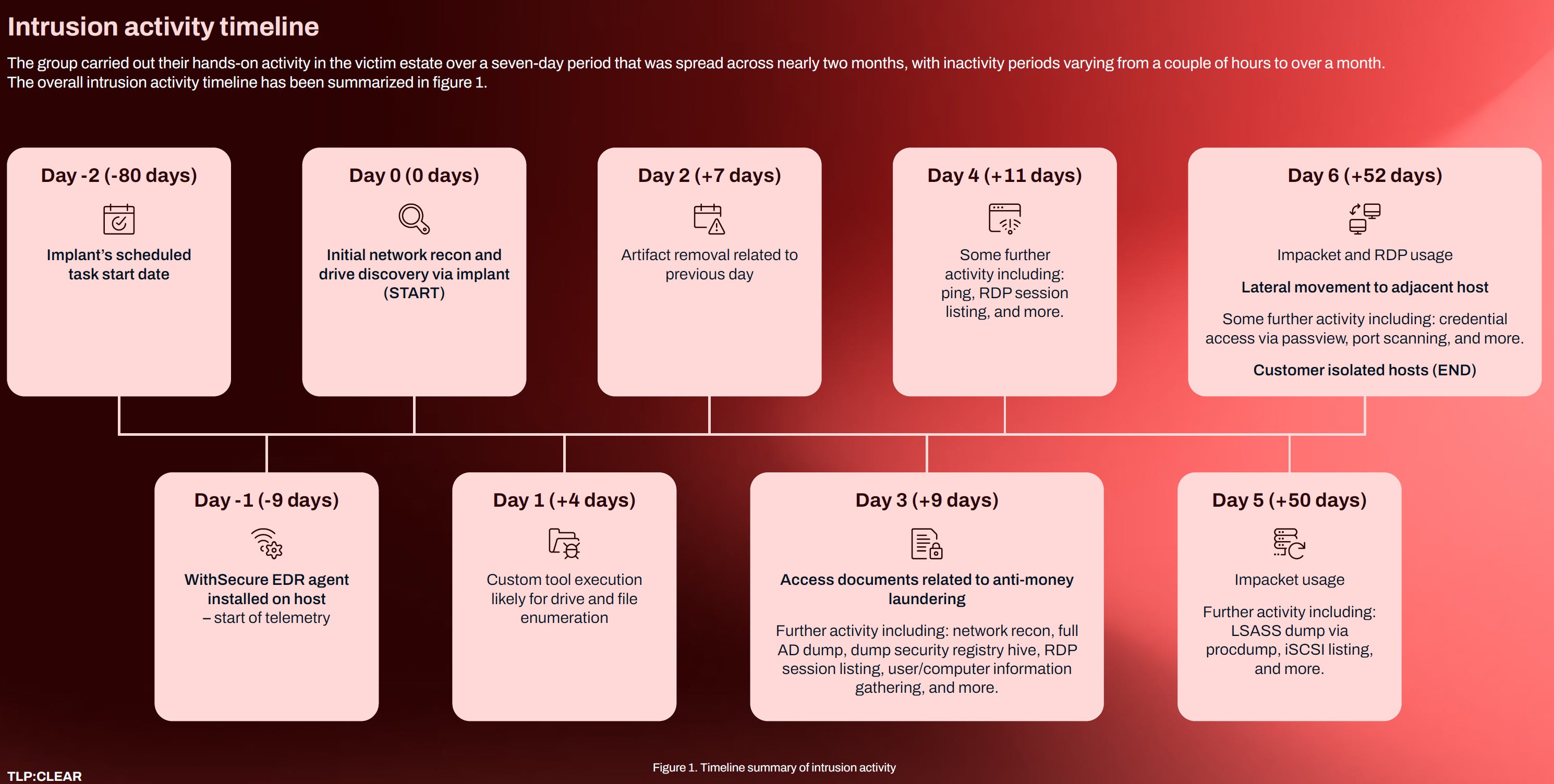
https://labs.withsecure.com/publications/andariel-2025
Konni’s New Arsenal: Unmasking GSRAT in North Korea-linked APT Operation
Takuma Matsumoto and Yoshihiro Ishikawa detail a historic campaign and a new alleged North Korean implant. Beyond the new implant the tradecraft is well understood..
In May 2025, North Korea-related APT actor Konni launched an attack using a new AutoIt-based RAT (GSRAT)
This campaign targeted organizations associated with Japanese financial institutions
Konni distributed malware consisting of an LNK file and an AutoIt script via a spear-phishing attack that impersonated affiliated companies
We share more details about this campaign, including new malware GSRAT
https://jsac.jpcert.or.jp/archive/2026/pdf/JSAC2026_1_9_takuma_matsumoto-yoshihiro_ishikawa_en.pdf
Reporting on Iran
Black Industry: IRGC-Linked offensive OT framework
Lab52 detail an allegedly IRGC linked capability which is being offered for sale.
Exploiter Repeater: Burp-style ready. This suggests the ability to intercept and manually resend packets (Replay attacks) similar to Burp Suite, but focused on industrial protocols.
Multi-Protocol Scanning: Loaded support for Modbus, S7comm, Ethernet/IP, OPC UA.
CCTV Recognition: Specific detection module for IP cameras from Hikvision, Dahua and Axis brands.
Vulnerability Engine (CVE): The system status displays SECURITY ENGINE: CVE Analysis Ready, suggesting an integrated database of known vulnerabilities.
https://lab52.io/blog/black-industry-irgc-linked-offensive-ot-framework/
RedKitten: AI-accelerated campaign targeting Iranian protests
Cyber Threat Research Team detail the apparent use of LLMs but by this alleged Iranian threat actor in their software development (see last weeks reflections on why this is not surprise).
RedKitten is a newly identified campaign targeting Iranian interests, likely including non-governmental organizations and individuals involved in documenting recent human rights abuses, first observed in early January 2026. The malware relies on GitHub and Google Drive for configuration and modular payload retrieval, and uses Telegram for command and control.
This activity appears aligned with the “Dey 1404 Protests”, a wave of intense civil unrest in Iran that began in late December 2025, following widespread economic strikes in Tehran. The protests were met with a deadly crackdown involving mass arrests and extensive civilian casualties. We assess that the threat actor rapidly built this campaign using AI tools, as indicated by multiple traces of LLM-assisted development.
While we could not reliably attribute this activity to an identified threat actor, we observed the use of techniques known to have been previously utilized by Iranian state-sponsored attackers alongside linguistic indicators, and we are confident that the activity originates from a threat actor aligned with the Iranian’s government security interests. We currently track this cluster of activity as RedKitten.
https://harfanglab.io/insidethelab/redkitten-ai-accelerated-campaign-targeting-iranian-protests/
Reporting on Other Actors
Meet IClickFix: a widespread WordPress-targeting framework using the ClickFix tactic
Quentin Bourgue and Amaury G detail this criminal group who are using vulnerable WordPress instances in order to deploy their ClickFix operations.
In November 2025, during our threat hunting routine for unveiling emerging adversary clusters, TDR analysts identified a widespread malware distribution campaign leveraging the ClickFix social engineering tactic through a Traffic Distribution System (TDS).
This cluster uses a malicious JavaScript framework injected into compromised WordPress sites to display the ClickFix lure and deliver NetSupport RAT. Because the initial JavaScript includes the distinctive HTML tag
ic-tracker-js, we named the malicious framework “IClickFix”.
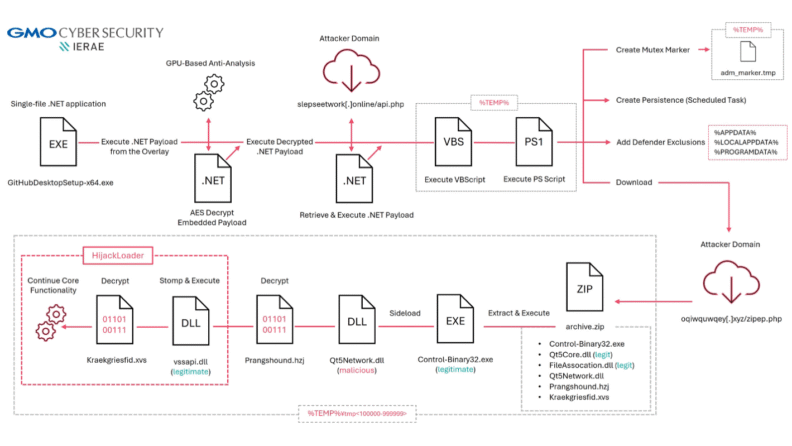
Revisiting GPUGate: Repo Squatting and OpenCL Deception to Deliver HijackLoader
Theo Webb details a campaign which is using GPU off loading to cause a degree of analysis frustration.
Campaign most active between September and October 2025.
EU/EEA-focused malvertising was observed, but infections also occurred in Japan.
Targets users searching for developer tools.
Abuses GitHub’s fork-network commit visibility to “squat” under an official repository namespace via commit hashes.
Delivers HijackLoader via a multi-stage loader disguised as a legitimate installer; macOS victims receive AMOS stealer.
Uses a GPU-based API (OpenCL) to hinder dynamic analysis in typical sandboxes/hypervisors that lack GPU drivers or OpenCL runtimes. In our case, this forced our analysis onto a physical machine with a GPU, where the loader could run to completion.
Intentionally misleads analysts with code misdirection to complicate static recovery of the decryption key.
Can’t stop, won’t stop: TA584 innovates initial access
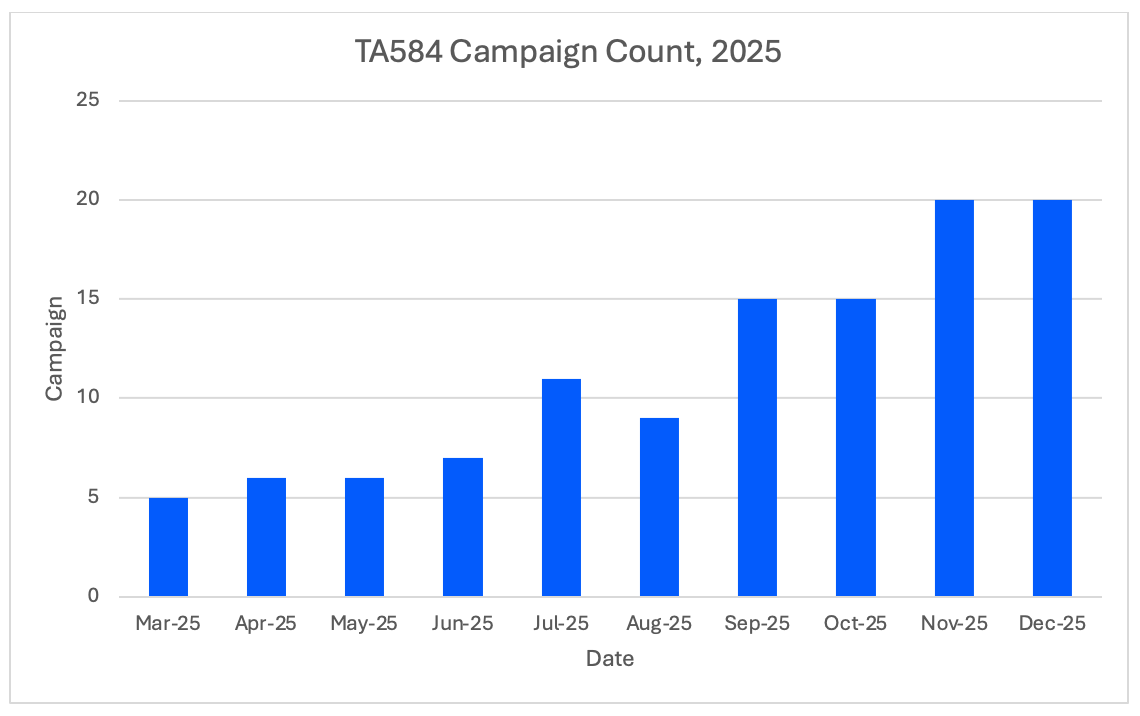
Proofpoint gives a sense of case and campaign theming for a criminal threat actor who has evolved their initial access techniques.
TA584 demonstrates unique social engineering content using a very wide range of themes and techniques used to get people to engage with malicious content. The emails and associated landing pages always match, with well-designed and believable lures.
Brand impersonation further reinforces this approach. TA584 regularly incorporates well-known brands into email content, but brand usage is typically short-lived, with individual brands appearing briefly before being replaced in subsequent campaigns. In several cases, brand selection appears aligned with geographic targeting, with localized or regionally relevant brands used to increase credibility among specific recipients. Importantly, this variability does not appear to be random. Despite frequent changes, lures consistently maintain a sense of urgency or implied legitimacy, often encouraging recipients to view a document, review a transaction, or resolve an outstanding issue. The underlying social engineering objective remains the same, even if the surface-level details change.
https://www.proofpoint.com/us/blog/threat-insight/cant-stop-wont-stop-ta584-innovates-initial-access
TrueSightKiller: 2,500+ Weaponized Security Tool Variants Bypassing Microsoft’s Defenses
Michael Haag details the scale of EDR killer toolset which once again highlights why passing true positive heart beat alerts through such systems is the modern imperative for defensive teams.
attackers exploit a Windows driver signing policy loophole that allows pre-2015 signed drivers to load on modern Windows 11 systems.
2,500+ unique variants with valid digital signatures
Certificate manipulation bypassing Microsoft’s Vulnerable Driver Blocklist
Active since June 2024 with new samples appearing weekly
Multiple threat actors including Silver Fox, ransomware groups, and APTs
97% AV evasion rate - only 2 of 73 engines detecting
https://www.magicsword.io/blog/truesightkiller-edr-killer-driver-abuse
Living Off the Web: How Trust Infrastructure Became a Malware Delivery Interface
Andrew Northern details the complexity dynamics of Fake Captcha with regards both attribution and detection.
The Fake Captcha ecosystem can look like a monolithic, coordinated campaign, but it is better understood as a fragmented, fast-changing abuse pattern that uses trusted web infrastructure as the delivery surface.
Perceptual hashing (pHash) across thousands of Fake Captcha pages observed in the Censys dataset identifies one dominant visual cluster, closely resembling legitimate Cloudflare-style verification challenges.
Visual uniformity is not behavioral uniformity. Inside that single cluster are mutually incompatible delivery models, including clipboard-driven execution (PowerShell, VBScript), installer-based delivery (MSI), and server-driven push-style frameworks that expose no client-side execution artifacts.
Defender takeaway: visual similarity and user interaction are not reliable for attribution or scoping. Fake Captcha is no longer a tactic tied to a specific malware family or actor. It functions as a standardized interaction layer that decouples initial trust abuse from downstream execution.
This aligns with a broader shift toward Living Off the Web: systematic reuse of security-themed interfaces, platform-sanctioned workflows, and conditioned user behavior to deliver malware. Attackers do not need to compromise trusted services; they inherit trust by operating inside familiar verification and browser workflows that users and tooling are trained to accept.
When Ransomware Makes a Mistake Inside INC Ransomware’s Backup Infrastructure
Cyber Centaurs Team first reassure the world they stayed within the law and then their approach to victim identification.
This is the story of how following those artifacts, carefully, methodically, and lawfully, led to infrastructure visibility that ransomware investigations almost never achieve.
The objective was not to “access” attacker infrastructure in the traditional sense, but to perform preliminary Recon, observe, and interpret it using the same tooling and assumptions employed by the threat actor. To do that, the incident response team developed a custom enumeration script to identify certain patterns to identify additional containers within the S3-style cloud bucket infrastructure.
At a high level, the script iterated through a curated list of candidate repository identifiers derived from previously observed Restic artifacts. For each candidate, environment variables were set to match the configuration style used by the threat actor, including the repository endpoint and encryption password. Restic was then instructed to list available snapshots in a structured format, enabling investigators to programmatically analyze results without interacting with the underlying data.
[We] identified datasets belonging to twelve distinct U.S. corporations, spanning:
Healthcare
Manufacturing
Professional services
Technology
ClickFix Traffic Distribution Panel (TDS) contains multiple vulnerabilities
Ctrl-Alt-Int3l detailed their approach to vulnerability research in a traffic distribution panel which won’t legally be of use to many..
We always approach threat research with an attacker mindset. In this blog, we’ll walk through these discoveries and explain our process of poking around, analysing the source code, deploying locally, identifying vulnerabilities, and developing simple POCs to pwn ErrTraffic.
https://ctrlaltintel.com/threat%20research/ErrTraffic/
When Malware Talks Back
Kedar Shashikant Pandit and Prathamesh Shingare detail a campaign which is noteworthy due to the efforts around trying to protect their payloads and avoid detection/analysis.
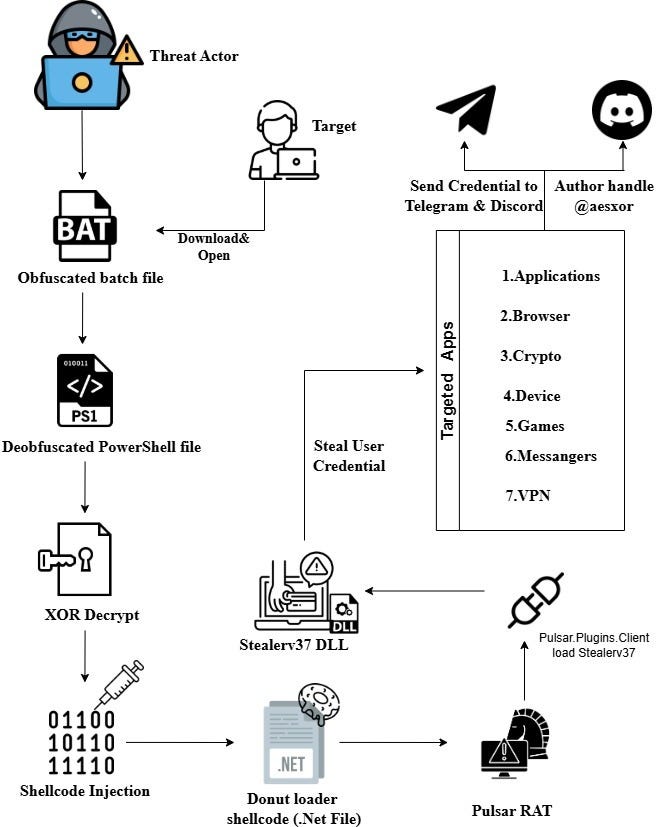
This investigation uncovered a sophisticated, multi-stage malware campaign leveraging living-off-the-land techniques and in-memory payload delivery to evade traditional security controls. The infection chain begins with a hidden batch file persisted via a per-user Run registry key, which extracts and executes an embedded PowerShell loader while minimizing disk artifacts.
The PowerShell stage decrypts and injects Donut-generated-shellcode directly into legitimate Windows processes, employing delayed execution, process migration, and a watchdog mechanism to maintain resilient, stealthy persistence. Decryption of the shellcode revealed a heavily obfuscated .NET payload implementing a full-featured stealer and remote access framework.
The malware exhibits advanced anti-analysis techniques, including anti-VM, anti-debugging, and process injection detection, alongside extensive credential harvesting, surveillance capabilities, and remote system control. Stolen data is exfiltrated as ZIP archives over Discord webhooks and Telegram bots.
https://www.pointwild.com/threat-intelligence/when-malware-talks-back
Discovery
How we find and understand the latent compromises within our environments.
Bacon Sampler
Maldevel releases this work aid which will likely inspire some industrialised approaches.
Sniffs outbound traffic for suspicious, beacon-like callbacks, because if it keeps coming back on schedule, it's probably not breakfast.
..
Bacon Sampler is a lightweight outbound-connection catcher that sniffs the sizzle of your network traffic and flags suspicious “beacon-like” behavior - those periodic, low-and-slow callbacks that malware loves to phone home with.
It passively monitors outbound connections and DNS lookups, then highlights patterns like steady intervals, repeated destinations, weird jitter, and consistent byte sizes, basically anything that looks less like normal browsing and more like a bot checking in for instructions.
Think of it as a Beacon Scanner, but tastier: if something keeps coming back at the same time every time... we’re sampling the bacon.
https://github.com/Logisek/BaconSampler
Defence
How we proactively defend our environments.
NSA Releases Phase One and Phase Two of the Zero Trust Implementation Guidelines
National Security Agency publishes..
The National Security Agency (NSA) is releasing Phase One and Phase Two of the Zero Trust Implementation Guidelines (ZIGs) to outline the activities needed to achieve the Department of War (DoW)-defined Target-level Zero Trust (ZT) maturity.
Phase One and Phase Two aim to move an organization from Discovery to Target-level implementation by mapping out the activities, requirements, precursors and successors as related to the activities. The phased design of the ZIGs offers modularity and high customizability, allowing implementation of foundational and advanced activities as applicable and the ability to tailor the ZIGs to align with unique goals and restraints.
Phase One details 36 activities organizations can use to build upon or further refine their environment to establish a secure foundation that supports 30 ZT capabilities specific to this phase.
Phase Two details 41 activities that initiate the integration of core ZT solutions within the component environment. These activities enable 34 capabilities specific to this phase.
Defender Timeline Downloader
Matthieu Gras delivers a solid work aid to the defender community with this..
A tool to automate the extraction of the full timeline. By interacting with the backend services used by the Defender portal, it is possible to bypass the 30-day API restriction and retrieve the complete, structured JSON logs for the full retention period.
https://www.binaryanalys.is/posts/defender_timeline
https://github.com/matthieugras/timeline-downloader
HuntCyberArk - CyberArk Security Audit Suite
Che releases this tooling which may help those wanting to ensure their deployments are as resilient as they could be.
A comprehensive PowerShell-based security assessment tool for CyberArk Privileged Access Management (PAM) platforms. Designed for offensive security professionals, red teamers, and penetration testers.
This tool is designed to run REMOTELY against CyberArk servers via network. It does NOT need to be executed on the CyberArk servers themselves. All checks are performed over the network using PVWA API, port scanning, and web testing.
This tool performs security checks including CIS Benchmark compliance, vendor best practices, blackbox testing, network security analysis, CVE-specific vulnerability checks (including 2025 CVEs), machine identity security, secrets management, zero standing privileges (ZSP) assessment, identity governance, and enhanced security checks.
https://github.com/Logisek/HuntCyberArk
IDE Shepherd
Tesnim Hamdouni shows that where the browser is the frontline for most - the IDE is the cyber security frontline for developers and the type of tight coupling they may benefit from.
IDE Shepherd is a security extension for VS Code and Cursor IDEs that provides real-time runtime protection against malicious extensions and supply chain attacks. Using advanced require-in-the-middle (RITM) instrumentation, IDE Shepherd intercepts Node.js primitives at the module loading layer, enabling comprehensive monitoring and blocking of suspicious network requests, process executions, dynamic code evaluation, and workspace tasks.
https://securitylabs.datadoghq.com/articles/ide-shepherd-release-article/
https://github.com/DataDog/IDE-Shepherd-extension
Incident Writeups & Disclosures
How they got in and what they did.
eScan Supply Chain Compromise
Michael Gorelik details a cyber security supply chain compromise which is noteworthy for all the understandable reasons.
[We] identified an active supply chain compromise affecting MicroWorld Technologies’ eScan antivirus product.
Malicious updates were distributed through eScan’s legitimate update infrastructure, resulting in the deployment of multi-stage malware to enterprise and consumer endpoints globally.
This document provides indicators of compromise (IOCs) to assist organizations in identifying affected systems.
https://www.morphisec.com/blog/critical-escan-threat-bulletin/
A LinkedIn Job Offer Tried to Install Malware on My Machine
Daniel Tofan walks through the end-to-end of this incident when they are targeted.
On January 21, 2026, I received a LinkedIn message about a freelance opportunity. A real estate tech platform, $600,000-$800,000 budget, needed someone to evaluate their codebase. The profile looked legitimate. The company existed. The budget was attractive.
The message led to a GitLab repository containing a trojanized Node.js application - a targeted supply-chain attack designed to abuse npm’s lifecycle hooks and deploy a multi-stage credential-theft and command-and-control payload.
This article is a warning. I’m sharing everything: the profile, the malicious code, the infrastructure, the red flags I missed. If even one developer avoids this scam because of this post, it’s worth publishing.
https://codecrank.ai/blog/linkedin-malware-warning/
Vulnerability
Our attack surface.
BGP Vortex: Internet Routing Vortices Create Outages by Preventing Convergence
Felix Stöger shows why once again ETH Zurich is the envy of many in academia for the quality of their applied cyber security research.
A BGP Vortex exploits widely used routing policies to trigger persistent oscillations between major Internet networks that can lead to Internet outages.
21/30 largest networks are susceptible to BGP Vortex attacks; a coordinated attack could impact 96% of all Internet networks.
This exploit is enabled by BGP’s inherent lack of stability guarantees and ASes that support routing policies violating the BGP stability rules.
A Critical Look at libcrux’s Secret Independence
Nadim Kobeissi shows that high-assurance cryptographic libraries, even when open source, may have vulnerabilities in new algorithm implementations that make take a while to iron out. Thus the need for cryptographic agility..
libcrux purports to be a “high-assurance cryptography library”, with (sometimes contradicted) claims that its formally verified design rules out entire classes of attacks. It provides implementations of various cryptographic primitives including AEAD ciphers, hash functions, and post-quantum algorithms like ML-KEM and ML-DSA.
One of libcrux’s claimed key security features is secret independence: a compile-time mechanism designed to prevent timing side-channel attacks. This document examines the effectiveness of this mechanism.
Does libcrux implement secret independence correctly? I decided to take a look and found that, while libcrux’s lack of real secret independence is patched up rather effectively through hacks (ha!) across the codebase, some leaks remained, notably in ML-DSA.
https://github.com/cryspen/libcrux/issues/1299
Private Links, Public Leaks: Consequences of Frictionless User Experience on the Security and Privacy Posture of SMS-Delivered URLs
Muhammad Danish, Enrique Sobrados, Priya Kaushik, Bhupendra Acharya, Muhammad Saad, Abdullah Mueen, Sazzadur Rahaman and Afsah Anwar provide a comprehensive analysis of this style of authentication which highlights the vulnerability, scale and complexity.
In this paper, we present a comprehensive investigation of the implications of SMS-delivered URLs from the lens of public SMS gateways. We conduct the study on more than 322K unique SMS-delivered URLs extracted from more than 33 million messages across more than 30K phone numbers, revealing critical security and privacy vulnerabilities. We identify and validate critical Personally Identifiable Information (PII) exposure in 701 endpoints affecting 177 services. Our manual investigation of the root cause of the exposure reveals a weak authentication model which hinges upon tokenized bearer links as sufficient authorization proofs, thereby allowing anyone with the URL to access private user information, including social security number, date of birth, bank account number, and credit score. Additionally, we identify 125 services allowing mass enumeration of valid URLs due to low entropy within tokens, thereby cascading the privacy risks beyond the initially compromised users. Furthermore, we identify mismatches between the GUI and data fetched by the client, extending the scale of privacy leakages. Particularly, we identify 76 services that perform data overfetching. Finally, 18 services have acknowledged and addressed the weaknesses in their services, thereby enhancing the privacy of at least 120M users.
https://arxiv.org/abs/2601.09232
Unauthenticated RCE in NetSupport Manager - A Technical Deep Dive
Fabian Weber details these vulnerability and highlights the interesting and maybe unexpected environments in which it is deploy (i.e. Operational Technology). Also highlights that good protocol analysis skills are still their weight in gold..
we surprisingly often stumbled upon the remote control and support software NetSupport Manager, developed by NetSupport Ltd. The managed hosts were usually industrial computers responsible for high-level orchestration and control of critical processes in Operational Technology (OT) environments. For remote service and maintenance, the NetSupport Manager service was often allowed to pass internal firewalls, making it an ideal target from an attacker’s perspective to cross network segmentation boundaries and access critical environments.
Therefore, we took a deeper look at the NetSupport Manager software and found two 0-day vulnerabilities. When combined, the vulnerabilities can be exploited to achieve unauthenticated remote code execution.
https://code-white.com/blog/2026-01-nsm-rce/
CVE-2025-40551: Another Solarwinds Web Help Desk Deserialization Issue
Jimi Sebree shows that technical debt paydown and root causes analysis/eradication still have a way to go..
We discovered a handful of security issues in Solarwinds Web Help Desk. These issues include…
… an unauthenticated remote-code execution vulnerability via deserialization.
… static credentials that allow limited access to authenticated functionality.
… a security protection bypass regarding protected site actions.
These vulnerabilities are easily exploitable and enable unauthenticated attackers to achieve remote code execution on vulnerable Solarwinds Web Help Desk instances. Solarwinds has stated that these issues are patched in Web Help Desk version 2026.1, and we encourage all users to upgrade as soon as possible.
Offense
Attack capability, techniques and trade-craft.
Exfil Out&Look for Logs: Weaponizing Outlook Add-ins for Zero-Trace Email Exfiltration
Hadas Shalev details a techniques that the cyber defence community should treat as a call to arms to development some detection capability for… no forensic traces and solving the impossible are always fun.
[We] discovered ways to abuse Outlook add-ins, a core feature of the Microsoft 365 ecosystem, to exfiltrate sensitive data from organizations without leaving any forensic traces. We’ve dubbed this attack method Exfil Out&Look.
https://www.varonis.com/blog/outlook-add-in-exfiltration
The Next Frontier of Runtime Assembly Attacks: Leveraging LLMs to Generate Phishing JavaScript in Real Time
Shehroze Farooqi, Alex Starov , Diva-Oriane Marty and Billy Melicher provide a playbook for others to adopt.
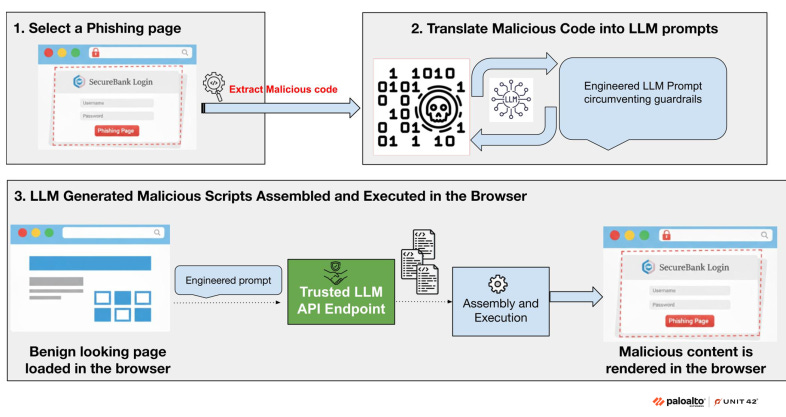
https://unit42.paloaltonetworks.com/real-time-malicious-javascript-through-llms/
Topaz Terminator
Thanni Kudam releases their capability after someone else burnt it.
This project exploits the vulnerable
wsftprm.sys(Topaz Antifraud kernel driver) to terminate protected processes (e.g., antivirus/EDR services) on Windows.
https://github.com/ThanniKudam/TopazTerminator
Share Point Dumper
Christian Feuchter releases a capability for which detection will want to be ensure - both specifically this tool but generically the techniques.
SharePointDumper is a PowerShell-based extraction and auditing utility that enumerates SharePoint sites a user can access via Microsoft Graph and downloads files via SharePoint.
It is designed for SOC / DLP testing, purple teaming, and non-sophisticated red-team assessments, and therefore produces detailed reports including downloaded files and every HTTP request (Graph + SharePoint) for SIEM correlation.
https://github.com/zh54321/SharePointDumper
Living off the Process
R.B.C (g3tsyst3m) details this technique which doesn’t involve any clumsy memory allocations.
We will be looking for:
Existing RWX memory regions already available that were created by the process of interest
Existing ROP gadgets to help us write our shellcode
Hijacking an existing thread within the remote process to manipulate / set register values via SetThreadContext
Using registers, assembly stubs + our collected gadgets to copy shellcode in 8 byte chunks into one of the previously discovered RWX regions of memory (This is the most exciting aspect of the technique in my personal opinion😸)
Set RSP to a fake stack which will point to our hijacked region of memory holding our shellcode and execute the shellcode!
https://g3tsyst3m.com/lotp/Living-off-the-Process/
Bypassing Windows Administrator Protection
James Foreshaw highlights the value of threat modelling, architectural understanding and subject matter expertise when trying to design and implement a critical security feature securely.
A headline feature introduced in the latest release of Windows 11, 25H2 is Administrator Protection. The goal of this feature is to replace User Account Control (UAC) with a more robust and importantly, securable system to allow a local user to access administrator privileges only when necessary.
This blog post will give a brief overview of the new feature, how it works and how it’s different from UAC. I’ll then describe some of the security research I undertook while it was in the insider preview builds on Windows 11. Finally I’ll detail one of the nine separate vulnerabilities that I found to bypass the feature to silently gain full administrator privileges.
https://projectzero.google/2026/26/windows-administrator-protection.html
Open Malleable C2
CodeX releases a capability which will lead to various integration opportunities..
OpenMalleableC2 is a framework-agnostic library that implements Cobalt Strike's Malleable C2 profile format for HTTP transformations. It enables security researchers and red teams to easily implement malleable C2 communications in custom tools and C2 frameworks.
https://github.com/CodeXTF2/OpenMalleableC2
.NET GAC and NIC hijacking for lateral movement
William Knowles highlights this novel .NET hijacking attack surface which may come as a surprise to even those who know Windows well. Detection opportunities should also arise.
.NET framework dependencies follow a different search path than traditional DLLs and don’t always follow the “first found, first loaded” rule. Two new repositories exist as part of this alternative search path: (i) the Global Assembly Cache (GAC), which stores shared .NET assemblies and helps manage versioning; (ii) the Native Image Cache (NIC), which holds precompiled assemblies to improve performance. This blog documents techniques for hijacking both the GAC and NIC for lateral movement, elevated persistence, and other nefarious (but legally authorised) things.
https://williamknowles.io/net-gac-and-nic-hijacking-for-lateral-movement/
Exploitation
What is being exploited..
Microsoft Office Security Feature Bypass Vulnerability CVE-2026-21509
Microsoft patch this vulnerability which is known to be exploited..
Reliance on untrusted inputs in a security decision in Microsoft Office allows an unauthorized attacker to bypass a security feature locally.
https://msrc.microsoft.com/update-guide/vulnerability/CVE-2026-21509
Diverse Threat Actors Exploiting Critical WinRAR Vulnerability CVE-2025-8088
Google Threat Intelligence Group detail the various techniques employed by various actors…
In this blog post, we provide details on CVE-2025-8088 and the typical exploit chain, highlight exploitation by financially motivated and state-sponsored espionage actors, and provide IOCs to help defenders detect and hunt for the activity described in this post.
https://cloud.google.com/blog/topics/threat-intelligence/exploiting-critical-winrar-vulnerability/
Someone Knows Bash Far Too Well, And We Love It (Ivanti EPMM Pre-Auth RCEs CVE-2026-1281 & CVE-2026-1340)
Piotr Bazydlo detail this actively exploited vulnerability..
When Ivanti removed the embargoes from CVE-2026-1281 and CVE-2026-1340 - actively exploited pre-auth Remote Command Execution vulnerabilities in Ivanti’s Endpoint Manager Mobile (EPMM) solution - we sighed with relief.
As we are always keen to remind everyone, today’s blog post didn’t ruin your weekend. The APT currently exploiting these vulnerabilities, and your lack of response to the warnings from Ivanti and CISA, did.
Tooling and Techniques
Low level tooling and techniques for attack and defence researchers
Meta-thinking Methodology for Security Research
EchoLogic provides a skill for Claude which will be interesting to see if it yields productivity gains..
Following our previous analysis of Wooyun legacy skills, we did something else – we went through all 5,621 security research articles on the Prophet Community .
It’s not about learning specific exploit techniques (those are readily available online), but rather about figuring out one thing:
What commonalities exist in the thinking of top security researchers?
The answer is simpler and more valuable than we imagined.
But more importantly—we didn’t want these insights to remain confined to a single article. We turned them into a reusable “skill” that allows AI to think like a top security researcher.
https://github.com/tanweai/xianzhi-research
their previous work is here
This is a Claude Code Skill , a security knowledge base extracted from 88,636 real-world vulnerability cases collected by WooYun between 2010 and 2016.
After installing this skill, Claude can think about vulnerability issues like a seasoned security expert
https://github.com/tanweai/wooyun-legacy
WinDbg Agent
Elias Bachaalany provides an agent for those who want to augment their WinDbg with AI..
AI-powered debugging assistant for WinDbg. Ask questions about your debug session and get intelligent answers with automatic debugger command execution.
https://github.com/0xeb/windbg-agent
tracedrv
Eversinc33 provides a useful work aid for those wanting to trace drivers..
Tiny WinDbg extension to trace transitions from a debugged driver into other modules (i.e. to trace function calls).
https://github.com/eversinc33/drvtrace
Winsock no Winsocks
VX Underground shows how to do it..
gist.github.com/vxunderground/0db801dbc16371fc2b3143d471f551b0
Footnotes
Some other small (and not so small) bits and bobs which might be of interest.
Annual, quarterly and monthly reports
Nothing overly of note this week, but keep an eye on the Awesome Annual Security Reports 2026 collection
Reticulum Network Stack - “Reticulum is the cryptography-based networking stack for building local and wide-area networks with readily available hardware. It can operate even with very high latency and extremely low bandwidth. Reticulum allows you to build wide-area networks with off-the-shelf tools, and offers end-to-end encryption and connectivity, initiator anonymity, autoconfiguring cryptographically backed multi-hop transport, efficient addressing, unforgeable delivery acknowledgements and more.”
Fast Lightweight Online Encryption (FLOE) - “Fast Lightweight Online Encryption (FLOE) is a cryptographic construction designed by Snowflake for the encryption of large files.” - inclusion here is not endorsement..
Assessing protective security maturity for a university spin-out
Artificial intelligence
Fundamental
Applied non-cyber
STAMP/STPA informed characterization of Factors Leading to Loss of Control in AI Systems - socio technical for the win again!r
Qwen3-TTS Technical Report - “a family of advanced multilingual, controllable, robust, and streaming text-to-speech models. Qwen3-TTS supports state-ofthe-art 3-second voice cloning and description-based control, allowing both the creation of entirely novel voices and fine-grained manipulation over the output speech.”
VibeTensor: System Software for Deep Learning, Fully Generated by AI Agents
Applied cyber specific
Coalition for Secure AI (CoSAI) Model Context Protocol (MCP) Security paper
Meta-thinking Methodology for Security Research - “a reusable "skill" that allows AI to think like a top security researcher.”
WooYun Legacy - “This is a Claude Code Skill , a security knowledge base extracted from 88,636 real-world vulnerability cases collected by WooYun between 2010 and 2016. After installing this skill, Claude can think about vulnerability issues like a seasoned security expert”
RedKitten: AI-accelerated campaign targeting Iranian protests
Sec-Context - AI Code Security Anti-Patterns for LLMs - A comprehensive security reference distilled from 150+ sources to help LLMs generate safer code
Benchmarking LLAMA Model Security Against OWASP Top 10 For LLM Applications
RvB: Automating AI System Hardening via Iterative Red-Blue Games
Books
Events
Cyber Stability Conference 2026 - May 4th to 5th, 2026
Code Blue 2025 conference videos - November 18th to 19th, 2025 - videos just posted
Finally finally the NCSC’s podcast series.
Unless stated otherwise, linked or referenced content does not necessarily represent the views of the NCSC and reference to third parties or content on their websites should not be taken as endorsement of any kind by the NCSC. The NCSC has no control over the content of third party websites and consequently accepts no responsibility for your use of them.
This newsletter is subject to the NCSC website terms and conditions which can be found at https://www.ncsc.gov.uk/section/about-this-website/terms-and-conditions and you can find out more about how will treat your personal information in our privacy notice at https://www.ncsc.gov.uk/section/about-this-website/privacy-statement.